


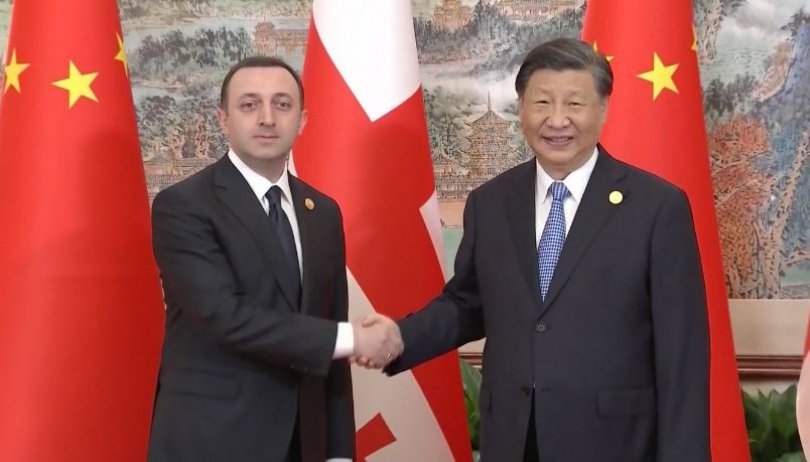
The news that Georgia and China have forged what they both call a 'strategic partnership' has added fuel to the argument that Tbilisi is drifting further away from the Euro-Atlantic space it still formally aspires to join.
The declaration came largely as a surprise. Prime Minister Irakli Garibashvili was known to be attending the opening ceremony of the Summer World University Games in China, mingling with the rather unusual crowd of leaders of Indonesia, Mauritania, Burundi, and Guyana.
The announcement coincided with rising tensions with both the EU and the US over the Georgian government's ambivalent attitude towards Russia, which continues to wage a war of aggression against Ukraine.
Prime Minister Irakli Garibashvili was not sparing in his praise for China's Xi Jinping. The wording he chose led some experts to describe Garibashvili’s positioning as that of a Chinese vassal.
"It was a great honor to meet President Xi, an exemplary politician, a wise national leader with a great vision," said Irakli Garibashvili.
Of particular concern is Article 1.3 of the Declaration, which expresses the Party's enthusiasm for "sharing governance experience to ensure mutual development and prosperity".
Exactly what "governance experience" will Georgia share with China?
Dea Ivaniadze of the Georgian Foundation for Strategic and International Studies (GFSIS) says the declaration reflects the interests of the Chinese Communist Party.
"This statement is in fact a statement by a member of the Chinese Communist Party camp," Ms Ivaniadze said, pointing to a few sentences from the joint Georgian-Chinese statement.
- "Georgia believes that China's modernization offers a new way and a new option for humanity to achieve modernization;
- "The two sides will strengthen coordination and cooperation in regional and international affairs and jointly uphold genuine multilateralism";
- "the two sides [...] promote the building of a community with a shared future for mankind".
In addition, while the statement explicitly mentions Georgia's support for the 'one China' principle, China merely 'reaffirms respect for sovereignty, independence, and territorial integrity'.
Unlike many countries that also support the One China principle, Georgia does not allow Taiwanese passport holders to its territory.
The PRC was one of 12 countries that voted against the resolution on the status of internally displaced persons and refugees from Abkhazia, Georgia, and the Tskhinvali region/South Ossetia, Georgia, at the UN in 2022.
The US ambassador to Georgia, Kelly C. Degnan, said that "it's up to the Georgian government to decide what kind of relationship it wants to have with China", adding that "many countries are turning away from the Belt and Road Initiative after a few years of seeing that it's not really very beneficial to other countries".
German Green MEP Viola von Cramon, one of the leading voices on Georgia in the European Parliament, was blunt in her criticism.
"While everyone else is trying to become more economically independent from China, Georgia is taking another turn," Ms von Cramon said.
Curiously, the joint declaration also includes a clause (6.1) on "strengthening exchanges and cooperation between the legislative bodies of the two countries in various fields and at various levels, as well as communication and consultation in relevant regional and international organizations". This is rather odd, given that China is a communist state with no real parliament.
The document contains a number of other clauses that are likely to anger Georgia's allies and friends in the West. Most notably, Georgia's support for China's "Global Security Initiative" - a pledge to "jointly uphold genuine multilateralism" - as well as its embrace of China's Belt and Road Initiative, which is now being abandoned by country after country.


 დახურვა