


Georgia’s Interior Ministry has been purchasing and expanding a facial-recognition system from a sanctioned Moscow-based company tied to Russia’s Federal Security Service since 2013, according to an investigation by AlgorithmWatch, a European digital rights watchdog.
The European digital-rights watchdog says the Polyface system, supplied by Papillon AO, has become the technological backbone of a wider surveillance operation used to identify, fine and intimidate anti-government demonstrators.
Papillon is sanctioned by the United States, Switzerland, Japan and Ukraine. Its products are used primarily by Russian law-enforcement agencies and governments closely aligned with Moscow, including Belarus, Kazakhstan, Tajikistan and Turkmenistan.
AlgorithmWatch reported that the Georgian Interior Ministry has signed six contracts connected to the system since 2013 and upgraded it five times. The ministry obtained a perpetual licence in October 2024, while a 2018 contract envisaged Georgian operators being trained directly by Russian personnel.
The investigation stresses that Papillon remains under Russian legal jurisdiction and, like other Russian companies, can be compelled to cooperate with Russian security agencies. This raises national-security concerns because the system processes biometric data belonging to Georgian citizens.
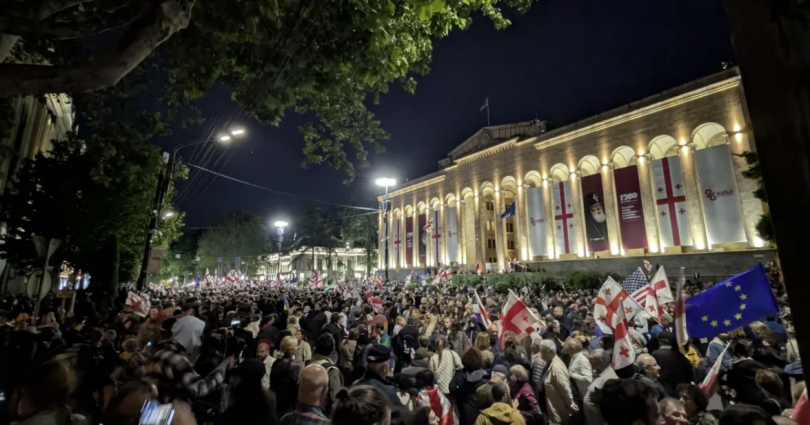
The surveillance expansion has coincided with increasingly draconian restrictions on protest. The fine for blocking a road rose from 500 to 5,000 lari, while covering one’s face at a demonstration was first made an administrative offence and later criminalized. By 2026, even standing or gathering on a pavement without prior state registration could lead to criminal prosecution and imprisonment.
AlgorithmWatch said the ministry received the latest Polyface version in June 2025, after authorities had already begun remotely identifying protesters and issuing heavy fines for allegedly blocking roads.
The software can scan large crowds in real time, operate in poor lighting and identify people wearing masks or partially covering their faces. It reportedly connects to Georgia’s civil-registry photographs through the Unified Information Bank and can also search images gathered from social media and other external sources.
Tender documents show that the ministry requested licences for an unlimited number of operators in 2024, removing a previous limit of 30 simultaneous users. AlgorithmWatch said the change indicated growing demand for monitoring demonstrations on a much larger scale.
The system can conduct automated crowd identification, operator-directed searches and watchlist alerts. Activists, protest organizers and previously fined demonstrators can reportedly be placed on lists that trigger an immediate alert when cameras detect them. That function has existed since the initial 2013 procurement.
The investigation describes how delayed fines, frozen bank accounts and the possibility of retroactive identification have driven many Georgians away from protests. Demonstrators told AlgorithmWatch they stopped chanting, carrying posters, wearing distinctive clothing or even walking near parliament because they feared being tracked.
AlgorithmWatch said the system can reconstruct a person’s entire protest history, including when they arrived, how long they stayed and how often they returned.
The investigation concluded that the Georgian authorities had achieved through biometric surveillance what force alone had failed to accomplish: weakening the protest movement through fear, financial pressure and the threat of imprisonment.





 დახურვა